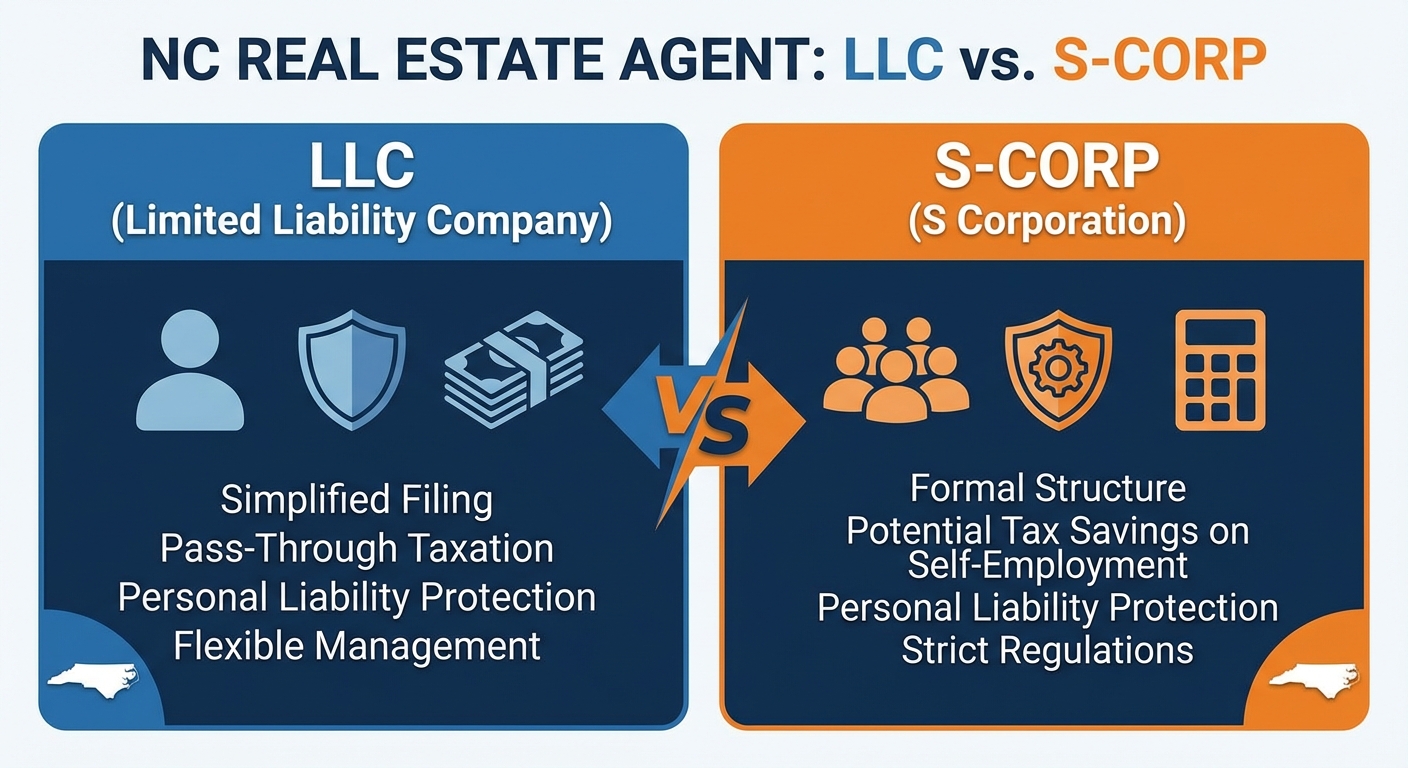
The Core Differences: Liability, Taxation, and Flexibility
The primary differences between an LLC and an S Corp for a real estate agent boil down to how you are taxed and the level of administrative formality required. Importantly, both structures offer significant liability protection, creating a legal barrier that helps separate your personal assets (like your home and savings) from business debts and lawsuits—a critical safeguard in the real estate industry.
According to guidance from the U.S. Small Business Administration (SBA), choosing the right structure is a foundational business decision [3]. Here's a breakdown of the key factors:
LLC (Limited Liability Company)An LLC is often considered the simplest formal business structure. For a solo agent, a single-member LLC is typically treated as a "disregarded entity" for tax purposes, meaning its financial activity "passes through" to the owner's personal tax return (Schedule C).
Tax Implication: The major tax consideration is that the owner pays self-employment taxes—currently 15.3% for Social Security and Medicare—on the entire net earnings of the business. Pros and Cons of LLC for Real Estate Agent: The primary advantages are ease of setup, minimal ongoing compliance, and high operational flexibility. The main disadvantage is that every dollar of profit is subject to that 15.3% self-employment tax, which can become substantial for high-earning agents. S Corp (Subchapter S Corporation)An S Corp is not a business entity itself but a tax election. An LLC or a corporation can file with the IRS to be taxed under Subchapter S of the Internal Revenue Code. This election fundamentally changes how the owner is compensated and taxed.
Tax Implication: The owner must be paid a "reasonable salary" as a W-2 employee. The business pays FICA taxes (the employee/employer version of self-employment taxes) only on this salary. Any remaining profits can be taken as distributions, which are not subject to self-employment taxes. Pros and Cons: The key advantage is the potential for significant tax savings on profits taken as distributions. The primarydisadvantages of S Corp for a realtor include increased complexity, the cost of running payroll, and stricter rules regarding finances and record-keeping.
Ultimately, determining the best business structure for real estate agents in NC involves a trade-off: the LLC's simplicity versus the S Corp's potential for tax savings. Let's see how this plays out for two real agents in the Charlotte market.
A Charlotte Case Study: Two Agents, Two Paths
To illustrate the financial impact of the S Corp vs LLC for NC real estate agents decision, let's meet two successful Charlotte real estate agents: "Agent A" and "Agent B." Both are top performers in the competitive Charlotte market, closing deals in desirable neighborhoods from Myers Park to Ballantyne. This year, they both had identical financial outcomes:
The only difference between them is their business structure.
Agent A: The Single-Member LLC
Agent A operates her business as a standard single-member LLC. This structure is known for its simplicity and minimal administrative burden.
Tax Calculation:Because her LLC is a pass-through entity, the full $110,000 of net income is subject to self-employment tax. The calculation is straightforward:
$110,000 (Net Income) × 15.3% (Self-Employment Tax Rate) = $16,830 in self-employment taxes.This $16,830 is paid in addition to her regular federal and North Carolina state income taxes on that same profit.
Administrative Burden:Agent A's administrative tasks are minimal. She pays herself by simply transferring money from her business bank account to her personal account as needed. This is called an "owner's draw." Her annual tax filing involves reporting this income on a Schedule C as part of her personal 1040 tax return.
Agent B: The LLC Taxed as an S Corp
Agent B also operates under an LLC but has filed IRS Form 2553 to be taxed as an S Corporation. This introduces a few more steps but offers a significant tax advantage.
The "Reasonable Salary":The first requirement for an S Corp is that the owner-employee must be paid a "reasonable salary." IRS guidelines state this salary should reflect what a similar business would pay for the same or similar services [1]. Considering her experience, performance, and local market data from sources like the UNC Charlotte Childress Klein Center for Real Estate, a real estate agent S Corp reasonable salary NC is determined to be $60,000 for this scenario [5].
Agent B's tax calculation is now split into two parts, which is key to understanding the llc taxed as s corp benefits:
- Salary: Her $60,000 salary is paid through a payroll system. This amount is subject to 15.3% FICA taxes (the equivalent of self-employment taxes, split between employer and employee).
- Distribution: The remaining business profit ($110,000 Net Income - $60,000 Salary = $50,000) can be taken as a shareholder distribution. This distribution is
By structuring her pay this way, Agent B's FICA tax bill is $9,180, compared to Agent A's self-employment tax bill of $16,830.
Gross Self-Employment Tax Savings: $7,650 The Costs & Administrative Burden:This savings isn't entirely free. Agent B incurs new administrative costs:
Payroll Service: ~$500 per year Additional Tax Prep: S Corps require a separate business tax return (Form 1120-S), which may cost an additional ~$400-$800 per year.She also has more administrative duties, including running payroll regularly, maintaining stricter bookkeeping, and filing quarterly payroll reports.
Case Study Conclusion: A Financial Snapshot
The following table, acting as a simple S Corp tax calculator for realtors, summarizes the financial difference between the two structures at this income level.
| Metric | Agent A (LLC) | Agent B (S Corp) |
|---|---|---|
| Net Business Income | $110,000 | $110,000 |
| Reasonable Salary | N/A | $60,000 |
| Income Subject to SE/FICA Tax | $110,000 | $60,000 |
| SE/FICA Tax Paid | $16,830 | $9,180 |
| Annual Admin Costs (Est.) | $150 | $1,100 |
| Net Tax Savings | - | ~$6,480 |
For a Charlotte agent earning $110,000 in net income, the S Corp election resulted in over $6,000 in net tax savings, even after accounting for the additional administrative costs. However, this required her to take on the formal role of an employee in her own business and manage the associated compliance.
The Step-by-Step Process in North Carolina
Setting up a business entity in North Carolina involves specific steps with both the NC Secretary of State and the NC Real Estate Commission. It's a manageable process that requires attention to detail to ensure full compliance.
Here is a general checklist for forming an LLC, which is the foundational step before considering an S Corp tax election:
- Choose and Register Your Business Name: Your first step is to select a unique name for your business. You must check for its availability on the
nc secretary of state business registrationportal to ensure it's not already in use. - File Articles of Organization (for an LLC): This is the official document that creates your LLC. You can file it online through the NC Secretary of State's website. Be prepared to pay the state filing fee, which is the primary
cost to set up LLC in NC for real estate. - Obtain an Employer Identification Number (EIN): An EIN is like a Social Security number for your business. It's required for opening a business bank account and is necessary for both LLCs and S Corps. You can apply for one for free on the official IRS website.
- Open a Business Bank Account: This is one of the most critical steps. You must keep your business and personal finances separate to maintain liability protection. All commission checks should be deposited here, and all business expenses paid from this account.
- NCREC Compliance - The Firm License: This is a crucial, state-specific step. According to the North Carolina Real Estate Commission (NCREC), any business entity (like an LLC) that conducts brokerage activities must obtain a firm license [2]. As a solo agent operating under an LLC, you must apply for this license and designate yourself as the Broker-in-Charge (BIC). This is a non-negotiable part of the
NC real estate firm license requirements. - (If Applicable) Electing S Corp Status: If you decide the tax benefits are worthwhile, the final step is the S Corp election. This is a tax step, not a formation step. To learn
how to form an S Corp in North Carolinafrom a tax perspective, you will file IRS Form 2553, "Election by a Small Business Corporation." Be mindful of the strict deadlines for filing this form. You must also register your business with the North Carolina Department of Revenue (NCDOR) for state tax purposes [4].
While these steps are straightforward, each one must be completed correctly to establish your business on solid legal and financial footing. Once the structure is in place, the focus shifts to maximizing its benefits through diligent financial management.
Maximizing Your Deductions as an NC Agent
Regardless of whether you choose an LLC or an S Corp, proactive expense tracking is the key to lowering your taxable income and keeping more of your hard-earned commission. The IRS allows real estate agents to deduct expenses that are both "ordinary and necessary" for their business [6]. A clear understanding of real estate agent tax deductions North Carolina can save you thousands of dollars each year.
Here are some of the most common, and sometimes overlooked, business expenses a realtor can deduct:
Vehicle Expenses: This is often the largest deduction. You can use either the standard mileage rate (a set amount per business mile driven) or the actual expense method (tracking a percentage of your gas, insurance, repairs, and depreciation). Meticulous record-keeping is essential for either method. Home Office Deduction: If you have a dedicated space in your home used exclusively for your real estate business, you may be able to deduct a portion of your rent, mortgage interest, utilities, and insurance. The IRS offers a simplified and a regular method for this calculation. Marketing & Advertising: This includes everything from Zillow Premier Agent fees and social media ad campaigns to traditional flyers, business cards, and yard signs. Software & Subscriptions: Your CRM subscription, MLS dues, bookkeeping software (like QuickBooks), and any other technology you use to run your business are fully deductible. Brokerage Fees: Any desk fees, franchise fees, or commission splits paid to your brokerage are considered a cost of doing business. Continuing Education & Licensing Fees: The costs of renewing your NC real estate license, taking continuing education courses, and earning professional designations are deductible. Client Gifts: You can deduct up to $25 per person per year for client gifts. Health Insurance Premiums: If you are self-employed and not eligible for a spouse's employer-sponsored plan, you can typically deduct the premiums you pay for health insurance.The foundation for claiming these deductions is separating business and personal expenses for realtors. Using a dedicated business bank account and credit card is the most effective way to create a clean, audit-ready record of your financial activity.
Frequently Asked Questions
At what point is an S Corp better than an LLC?
An S Corp election typically becomes more beneficial than a standard LLC when a real estate agent's net income consistently exceeds $60,000-$70,000 annually. Below this threshold, the potential self-employment tax savings are often offset by the costs of payroll and administration. The decision depends on your specific income, expenses, and willingness to manage the increased formalities.What is the best business type for a real estate agent in NC?
For most NC real estate agents, a single-member LLC is an effective starting business type due to its liability protection and simplicity. As income grows, an LLC that elects to be taxed as an S Corporation can become the optimal choice for maximizing tax savings. A sole proprietorship is generally not recommended as it offers no personal liability protection.How do I pay myself as a real estate agent with an LLC?
As a single-member LLC, you pay yourself through an "owner's draw." This involves simply transferring funds from your business bank account to your personal account. There is no payroll or tax withholding on these draws. You are responsible for paying estimated quarterly taxes on the LLC's total net profit throughout the year.Does North Carolina recognize S Corps for realtors?
Yes, North Carolina fully recognizes the S Corp tax election for real estate agents. Realtors can form an LLC or corporation and then file with the IRS to be taxed as an S Corp. You must also comply with all NC Department of Revenue requirements for corporations and NCREC rules for firm licensing.Do real estate agents have to pay quarterly taxes in NC?
Yes, since real estate agents are considered self-employed, they are required to pay estimated taxes quarterly to both the IRS and the North Carolina Department of Revenue. This applies whether you operate as a sole proprietor, LLC, or S Corp. These payments cover your income tax and self-employment tax liabilities for the year.Can you write off your car as a real estate agent?
Yes, you can deduct expenses for the business use of your car. You can choose one of two methods: the standard mileage rate (a set rate per business mile driven) or the actual expense method (deducting a percentage of your gas, insurance, repairs, and depreciation). You must keep detailed records to support either method.Limitations, Alternatives & Professional Guidance
It's important to approach this decision with a clear understanding of its context and limitations. Tax laws and regulations can change, and the financial models presented in our case study use current rates for illustrative purposes only. Furthermore, the concept of a "reasonable salary" is subjective and can be scrutinized by the IRS. The $60,000 figure used is a reasonable example for the Charlotte market but may not be appropriate for every agent's specific situation, experience, and workload.
While the LLC and S Corp are the most common structures, there are alternatives. A sole proprietorship is the simplest way to operate, but it offers zero liability protection, leaving your personal assets exposed to business risks. This makes it an unsuitable choice for most professional agents. On the other end of the spectrum is the C Corporation, which is generally overly complex and tax-inefficient for individual agents, though it may be considered for very large teams or brokerages seeking to raise capital from outside investors.
Because every agent's financial situation is unique, it is strongly advised that you consult with a qualified professional. A CPA or a specialized bookkeeper who understands the nuances of the real estate industry can provide a personalized analysis. They can review your specific income, expenses, and future business goals to help you determine the optimal structure that balances tax efficiency with administrative practicality.
Conclusion
The decision between an LLC and an S Corp is a strategic trade-off that every successful North Carolina real estate agent must consider. The LLC offers foundational liability protection with welcome simplicity, making it an ideal starting point for agents or those with fluctuating income. The S Corp election, on the other hand, presents a powerful opportunity for significant tax savings for higher-earning agents, but it comes with unavoidable administrative duties and costs. As our Charlotte case study demonstrates, there is often a clear financial tipping point where the complexities of an S Corp become well worth the effort. Ultimately, choosing the right structure between an S Corp vs LLC for NC real estate agents is a foundational business decision that will impact your profitability and administrative workload for years to come.
Navigating this complexity is precisely why specialized guidance is so valuable. As a real estate CPA Charlotte NC area bookkeeping firm, we help agents with these exact challenges every day. We help you not only choose the right structure but also manage it effortlessly, ensuring your finances are organized, compliant, and optimized for tax savings. If you're ready to build a financially sound real estate business, let's talk. Schedule Your Free Consultation today and get clarity on your best path forward.
References
- Internal Revenue Service (IRS). (n.d.). S Corporation Compensation and Medical Insurance Issues.
- North Carolina Real Estate Commission. (n.d.). Official Website.
- U.S. Small Business Administration (SBA). (n.d.). Choose your business structure.
- North Carolina Department of Revenue (NCDOR). (n.d.). Official Website.
- UNC Charlotte, Belk College of Business. (n.d.). Childress Klein Center for Real Estate.
- Internal Revenue Service (IRS). (n.d.). Licensed Real Estate Agents - Real Estate Tax Tips.